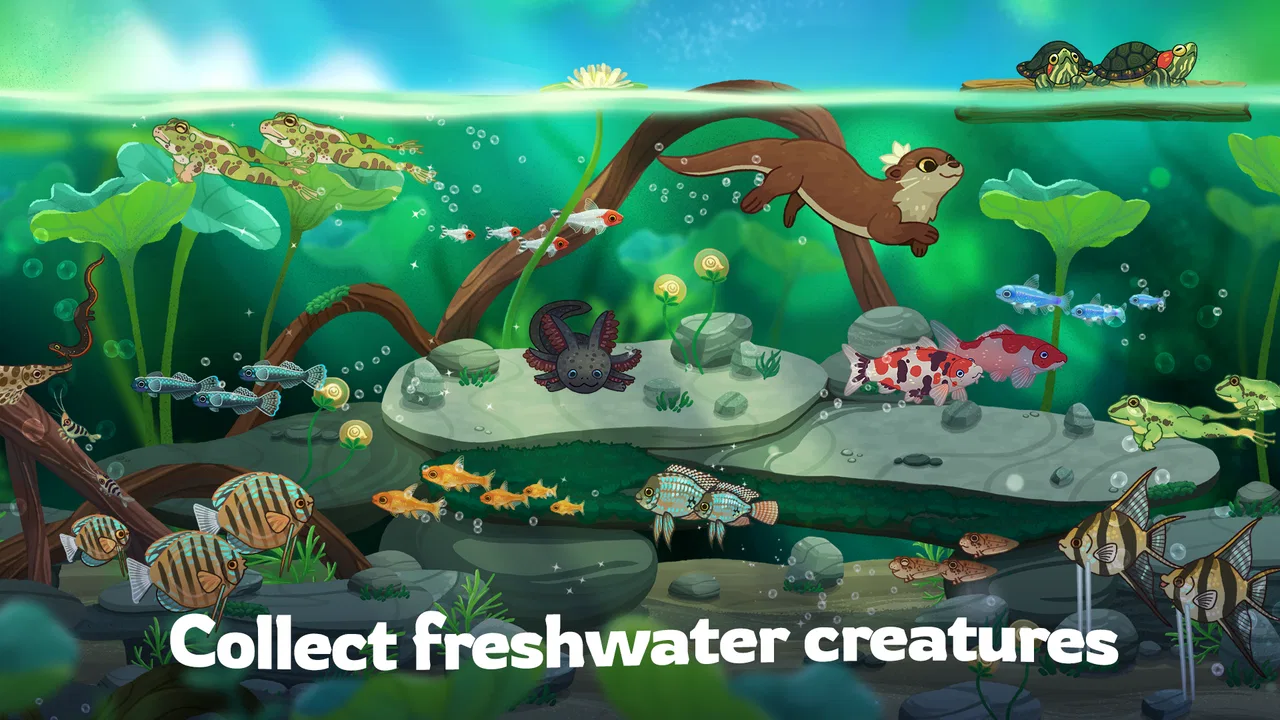
Pondlife — Fish, Frogs & More!
- 4.6
- Rating
- 1.00M
- Installs
- Free
- Price

 Analysis by App-foxy
I went into Pondlife — Fish, Frogs & More! expecting a small, quiet simulation game, and that is exactly where its appeal lies. It is not trying to turn pond care into a complicated management job or a competitive challenge. Instead, it gives me a gentle space to feed aquatic creatures, watch the pond develop, and spend a few calm minutes making small improvements. My overall view is simple: this is a good choice when I want a low-pressure game that fits around my day, but it is not the right pick if I need deep strategy, constant action, or a strong sense of urgency.
Developed by Runaway Play, this free simulation game is aimed at Everyone and works on Android 7.1 or later. It has already passed the million-install mark, which makes sense once I understood its rhythm. The game is easy to approach, visually friendly, and built around short visits rather than long sessions. Its current version is 1.25.11, and the experience feels designed for players who would rather check in regularly than sit down for an intense evening of gaming.
Why the pond works so well as a relaxing game
The strongest part of Pondlife is its mood. Feeding fish and frogs feels more like tending a small living scene than completing a demanding set of objectives. I can open the game, look around, handle a few tasks, and leave without feeling that I have wasted time. That makes it especially comfortable during a break, while waiting for an appointment, or at the end of a busy day when a more competitive game would feel like work.
You May Also Like

 Blood Strike: 2.5 Anniversary
Blood Strike’s Loadouts Turn Every Drop Into a Tactical Gamble
A close look at Blood Strike’s custom loadouts: how fast access to signature weapons reshapes its battle royale rhythm, rewards preparation, and narrows the gap between fights.

 Pandora - Music & Podcasts
Pandora’s Music Is Easy to Start, but Harder to Recover
Pandora’s strength is its low-effort path from a seed to a station. Its weak spot is how much confidence it asks you to place in connection, setup, and quiet recovery.

 8 Ball Pool
 Is Built on Rivalries, Rematches, and Routine
A close look at the rivalries, rematches, shared routines, and unanswered safety questions that turn a quick pool match into a persistent mobile community.

 Samsung Music
’s Quiet Strength Is Playing What You Already Own
Its reach comes less from spectacle than from dependable access to a personal library. That simplicity is both the app’s strongest retention engine and its ceiling.

 AccuWeather: Weather Radar
AccuWeather Review: A Quick, Clear Forecast for Everyday Decisions
For everyday plans, the best forecast is the one you can understand quickly. AccuWeather makes rain timing, radar, and local conditions easy to act on, with a few trade-offs.

 Hill Climb Racing
Why Hill Climb Racing Still Turns Crashes Into One More Run
A tiny car, a bumpy hill and one more upgrade: Hill Climb Racing keeps resurfacing because its simple chaos makes every near-miss feel personal.
More From Our News Desk



The pond setting also gives the game a useful sense of identity. Many casual simulations rely on farms, cafés, houses, or cities, so the aquatic theme immediately makes this one feel different. Fish and frogs are not just decorative replacements for familiar characters; they support the slower pace. Watching a pond gradually become more lively is satisfying because the setting itself encourages patience.
I found that the best way to enjoy it is to treat each visit as a small routine. I check what needs attention, feed the creatures, look for anything that has changed, and then decide whether I want to continue or close the game. That approach prevents the experience from becoming repetitive too quickly. It also makes the game a useful companion for people who enjoy gentle progress without needing a large story or a complicated objective list.
The public response supports that impression. Pondlife holds a 4.6 average from around eighteen thousand ratings, alongside roughly one and a half thousand written reviews. Those figures do not prove that every player will enjoy the same pace, but they do suggest that the relaxed design is connecting with a substantial audience. In my experience, the game earns that goodwill by keeping its basic interaction understandable from the start.
A simple loop that suits short sessions
The central loop is easy to grasp: care for the pond, feed its inhabitants, and help the environment become more appealing over time. I never felt forced to learn a dense collection of systems before I could enjoy the game. That matters on mobile, where a player may only have a few minutes and may not remember every detail from a previous visit.
One useful habit is to avoid tapping through everything as quickly as possible. I get more from the game when I pause to notice which creatures are active and which parts of the pond look different after a period away. The visual changes are part of the reward, so rushing can make the game feel thinner than it really is. This is a title where attention, rather than speed, improves the experience.
Another practical tip is to use it as a transition game. I would not open it expecting a long, dramatic session. Instead, it works well before bed, after finishing a study task, or during a short commute when I want something that does not demand complete concentration. Because the game is free to start, it is easy to test whether that kind of routine fits my habits without making an upfront purchase.
That free entry point is helpful, although it comes with optional in-app purchases ranging from $0.99 to $99.99 per item. I recommend deciding early whether I am comfortable playing within the free path or spending occasionally. A relaxed game can lose some of its charm if I begin treating every attractive improvement as something I should buy immediately. For me, the better approach is to enjoy the regular care loop first and consider purchases only if they genuinely add value to the way I play.
What makes the creatures more than decoration
Fish and frogs give the pond a sense of activity that a static collection game would not have. Even when I am not pursuing a particular goal, the creatures make the space feel inhabited. That creates a subtle emotional reward: I am not merely arranging objects on a screen, I am maintaining a small environment that becomes more pleasant as I return to it.
This is also where the game can appeal to younger players, provided an adult is comfortable with the presence of optional purchases. The Everyone rating reflects the approachable tone, and the controls are not intimidating. Still, I would not hand a child an unsupervised device and assume that a free game has no spending considerations. The purchase range is significant enough that families should set their own boundaries before letting a child play.
For adults, the same simplicity can be either a strength or a weakness. I enjoyed not having to memorize complex rules, but players who want breeding systems, detailed resource chains, or elaborate pond design may eventually want more depth. Pondlife is strongest as a calming caretaker game, not as a serious ecosystem simulator. Keeping that expectation clear is important before downloading it.
The trade-off: calm design versus long-term pressure
The main limitation is the same feature that makes the game pleasant. Its gentle pace means that it may not provide enough tension for players who need constant goals. There is no reason to expect the same rush I would get from a time-limited challenge, a competitive multiplayer match, or a management game with strict failure conditions. If I am looking for a title that tests quick decisions, this pond will probably feel too quiet.
Repetition is another possible friction point. Feeding creatures and checking the environment can be soothing for a while, but the loop depends on the player enjoying small changes. I would not recommend it to someone who loses interest unless a game regularly introduces new mechanics or dramatic events. The experience asks me to appreciate gradual progress, and that is a personal preference rather than a universal strength.
There is also a difference between relaxing and completely effortless. I still need to remember to return, pay attention to what the pond needs, and decide how to use the available progress. If I open it expecting an interactive screensaver, I may find the routine more involved than expected. Conversely, if I want a detailed simulation with meaningful consequences for every decision, I may find the choices too light.
The presence of purchases creates a second trade-off. A free game has to make room for optional spending, and that can influence how I evaluate progress. I prefer to play Pondlife slowly rather than compare my pond with an imagined ideal version that might be reached faster through purchases. Anyone who dislikes free-to-play structures should approach it carefully, even though the basic download costs nothing.
How it compares with familiar simulation alternatives
Compared with a farming simulation, Pondlife feels less like a production schedule and more like a quiet display that I gradually care for. A farm usually asks me to plant, harvest, sell, expand, and manage several resources. This game is a better fit when I want fewer obligations and a more focused theme. The trade-off is that I should not expect the same breadth of crafting, building, or economic planning.
Compared with a city-building game, the pond is much less demanding. I am not balancing roads, residents, services, or large-scale expansion. That makes it easier to play in short bursts and easier to recommend to someone who finds city builders overwhelming. On the other hand, players who enjoy seeing a complex system grow may feel that Pondlife does not offer enough control over a larger world.
It also differs from a traditional idle game. Idle titles often emphasize numbers rising while the player is away, with frequent upgrades and optimization decisions. Pondlife has a more personal atmosphere because the creatures and the setting are the focus. I would choose it when I want to look at a pleasant environment, not when I want to maximize statistics or chase the most efficient upgrade path.
That comparison helped me understand who should skip it. If my ideal mobile game includes combat, story twists, ranked competition, or a deep collection system, this is unlikely to replace it. If I already enjoy aquarium-themed relaxation, small virtual pets, or peaceful management games, it has a much better chance of becoming a regular part of my app library.
Practical ways to get more from each visit
My first recommendation is to set a modest session goal. Instead of opening the game with the vague intention of playing until I get bored, I choose one small purpose: care for the creatures, inspect the pond, or make one improvement. This keeps the experience focused and stops the simple loop from feeling like an obligation.
Second, I would avoid judging progress only by how quickly the pond changes. The game is more rewarding when I notice the atmosphere and the growing variety of life. Players who constantly measure advancement against faster games may overlook its best quality. The useful mindset is closer to tending a digital garden than completing a checklist.
Third, I would keep purchases separate from the basic enjoyment test. I can play long enough to decide whether I genuinely like the pond before spending anything. If the free routine already feels repetitive, buying an item is unlikely to solve the underlying problem. If I enjoy returning and simply want to support a particular style of play, an occasional purchase becomes a more informed choice.
Finally, families should discuss spending before sharing a device. The age rating makes the tone accessible, but the available purchase range still deserves attention. That small conversation can preserve the relaxed nature of the game and prevent an otherwise pleasant activity from becoming a source of frustration.
Who should download it, and who should pass
I would recommend Pondlife to people who want a peaceful simulation with a clear theme and a forgiving pace. It is particularly suitable for casual players, fans of virtual habitats, and anyone who likes checking in on a game rather than committing to a long session. It can also work as a gentle introduction to simulation games for someone who finds farms and cities too busy.
I would be more cautious about recommending it to players who need constant novelty. The pond does not seem designed to keep me under pressure, and that means the experience depends heavily on whether I enjoy repetition with gradual visual rewards. Players who want a strong narrative, high-stakes decisions, or detailed customization should look toward a more ambitious alternative.
For me, the clearest use case is an everyday pause: I finish a task, open the pond for a few minutes, feed the fish and frogs, take in the changes, and close it before the activity turns into another demand on my attention. That is a narrow purpose, but Pondlife serves it well. It does not need to become my main game to be worthwhile.
The developer, Runaway Play, has positioned this as a friendly mobile simulation rather than a demanding strategy product, and that focus is apparent in the overall design. The game knows what kind of mood it wants to create. Its weakness is that the same focus leaves less room for players who want complexity, urgency, or a large number of competing systems.
After spending time with it, I see Pondlife as a pleasant specialist rather than an all-purpose mobile game. It is free to try, accessible on older Android devices beginning with version 7.1, and supported by a large player base. Those details make it easy to sample, but the real decision comes down to temperament: do I want a calm pond to revisit, or do I want a game that constantly pushes me forward?
My final verdict is positive, with a clear condition: choose Pondlife for relaxation, not intensity. I like its aquatic setting, its approachable care loop, and the way it turns a few spare minutes into a small ritual. I also recognize that its repetition, optional purchases, and limited pressure will not suit everyone. For the right player, though, it offers a welcoming little world where fish, frogs, and quiet progress are enough to make a short break feel better.
FAQs for Pondlife — Fish, Frogs & More!
01What is Pondlife — Fish, Frogs & More!?
Pondlife — Fish, Frogs & More! is an educational nature app focused on the animals and small organisms commonly found in ponds and freshwater habitats. It is designed to help users identify and learn about fish, frogs, insects, amphibians, and other pond life through accessible information and interactive content. It can be useful for curious children, families, students, and anyone interested in observing nature.
02Is Pondlife — Fish, Frogs & More! suitable for children?
The app is generally well suited to children who enjoy animals, science, and outdoor exploration, especially when used alongside a parent, teacher, or adult. Its subject matter is presented as a learning experience rather than a competitive game. However, parents should still check the app’s current age rating, privacy policy, advertising practices, and any external links before allowing younger children to use it independently.
03Does Pondlife — Fish, Frogs & More! work without an internet connection?
Offline availability may depend on the version of the app and the specific content being accessed. Some educational pages or previously loaded material may remain available without a connection, while updates, external resources, downloads, or certain interactive features could require internet access. If you plan to use the app during a pond walk or school trip, open it beforehand and test the important sections while connected.
04What can users learn from Pondlife — Fish, Frogs & More!?
Pondlife — Fish, Frogs & More! introduces users to the variety of creatures that live in or around freshwater ponds. Depending on the available sections, users can explore animal characteristics, habitats, behavior, life cycles, and relationships within the pond ecosystem. It is particularly helpful for encouraging observation and vocabulary, although it should be treated as an introductory resource rather than a replacement for a detailed field guide.
05Is Pondlife — Fish, Frogs & More! free to download and safe to use?
The app’s price, in-app purchases, advertisements, permissions, and privacy terms can vary by platform and may change over time, so users should check the official Google Play or App Store listing before downloading. Review the requested permissions carefully and use parental controls when appropriate. Downloading from official stores is the safest option and helps ensure that you receive the legitimate, current version.
Pros
- Relaxing pond simulation with fish
- frogs
- insects
- and aquatic plants.
- Simple controls make it easy to interact with pond life.
- Calm visuals and sounds create a soothing experience.
- Varied creatures add interest and encourage regular exploration.
- Suitable for short sessions when you want a peaceful distraction.
Cons
- Progress may feel slow if you prefer fast-paced gameplay.
- Limited action can become repetitive after extended play.
- Some creatures or features may require in-app purchases.
- The tranquil design may not appeal to players seeking challenges.
- Performance and battery use can vary on older mobile devices.

Pondlife — Fish, Frogs & More!
Gallery